Daily Care
Daily Care
This section contains a range of practical tips and advice from our therapy team on daily care of your child.
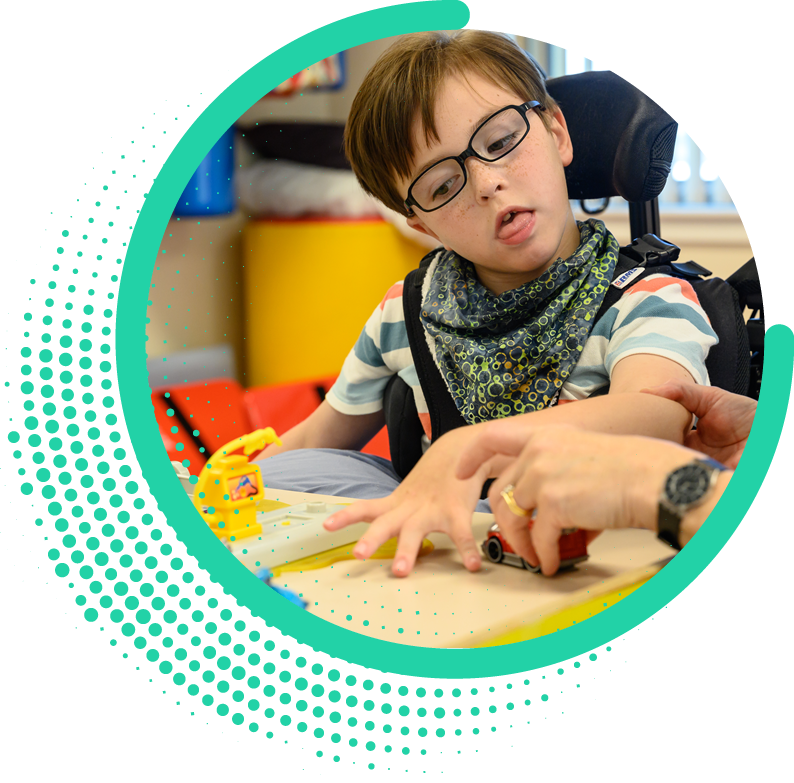
When children learn to do everyday things in more efficient ways (using less force and effort) they will become less tired and do not develop unhelpful ways of doing things. Specialist therapists can show a family ways to handle and play with their child that encourage and best support movements and engagement – so they experience success and have fun while learning.
Tips & Advice
Dressing
Dressing is a super activity to work on with a child with CP:
It is already part of daily routines – so in not an extra thing to fit in
It involves many different skills e.g. balance, hand function, sequencing etc
It can be used with all types and levels of Cerebral Palsy
It has a useful end result!
Here are a few pointers to consider:
Level of ability
Children of all types and levels of cerebral palsy can get involved with un/dressing. Regardless of a child’s individual challenges, with patience and time, it is possible for them to learn ways they can actively participate in the process. This is particularly important for children who are dependent for most aspects of their care. By learning how they can get involved, they are less likely to become ‘passive’ (letting everything be done for them) and instead have a drive to also engage in other ways. Easy ways to engage is asking them to choose what they want to wear or whether they want to do ‘tops or bottoms’ first.
Being realistic with time
Mornings are usually busy. Everyone is in a hurry and there is not usually time to spare. It is often easier to dress a child rather than use this time for learning and development. Sometimes evenings or weekends are more realistic – set aside specific time rather than rushing the task.
Undressing / Dressing?
It is usually much easier to remove clothes so start with undressing. Taking off pyjamas, socks and slippers are usually a good place to start as these items are also loose-fitting. Starting with more manageable steps helps the child feel successful and more inclined to try harder parts later on.
Grading tasks
Occupational therapists will often recommend that tasks are broken into smaller, manageable steps using what is called:
1. Back chaining: This is where the adult does most of the task but gets the child to do the last step. Once they have learnt that step, they are encouraged to do the second-last step….and continue working until they have learned all the steps.
2. Forward chaining: getting the child to do the first part of a task, then the adult completing the rest of the task for them. Once they have mastered the first part, they are encouraged to do the following step too, and so continuing to work through the sequence of steps.
When using a chaining method it is important to wait for the child to master one step before proceeding to the next, even if this takes a long time. Additionally, for some children it may not be physically possible for them to master all steps – but it is important that they are expected to what they can do.
Managing when arms feel stiff/hard to move
This is a common difficulty for many children with cerebral palsy. When putting tops on, deal with the sleeve on the tighter side first. When removing tops, allow the more flexible arm to come out first. Therapists will be able to provide more individual-specific ideas on how to manage tone to help with this.
Choosing clothes
The type of clothing used when practising dressing can have a big impact on how a child learns and/or if they keep motivated or quickly become frustrated. It is important that any child learns the technique first, and then learn to do it in more tricky situations. For example:
1. When learning buttons – start with big chunky buttons, not a school shirt.
2. When learning to get tops on/off – start with a larger sizes/loose-fitting t-shirt of jumper.
Generally, stretchy clothes including trousers/skirts with elasticated waists are easier. Consider buying the next size up especially if getting arms through sleeves is a struggle. Many high street brands now try to provide ranges of clothes and shoes more suitable for children with additional needs.
Have fun!
Children are more likely to learn and be prepared to repeat something when they find it fun or it appeals to their competitive nature, for example:
1. Dressing up costumes
2. Trying on mum/dad / big brother/sister’s clothes
3. Hoops & Hairbands game (adult places hoops/hairbands onto child’s legs/arms. The child has to remove them. This can be done with a timer, or simply count how many they manage. Start with loose hoops and work towards elasticated hair bands.) When they get good at this, then switch so they have to try getting them all again.
Mobility
Young children are quick to adapt to their limitations. The only downside is, in compensating for a limitation in movement they may also form bad habits.
Moving in restricted ways means a child can use some muscles too much, and others not enough. As a result, certain muscles aren’t encouraged to lengthen and stretch as they would in a natural pattern of movement. If not used, the muscles can shorten and this is how contractures can develop.
“I worked with one little girl who kept tripping over in the playground. She was very able, she just needed some extra help to improve her balance.”
Lesley, Cerebral Palsy Scotland physiotherapist
Problems with mobility aids
Like a pair of new shoes or glasses, it can take time to adjust to a mobility aid such as a standing frame or wheelchair. If you feel your child is only tolerating their equipment it is best to get to the bottom of it.
Equipment may be uncomfortable if your child has taken a growth spurt and certain muscles have become tighter and joints are not as easy to position. Your child may not like the feeling of being ‘restrained’ in equipment – building up time in spent in equipment can be useful. There may be ways to make it more enjoyable, such as only standing to eat or doing artwork.
Your child may need some help doing some gentle stretches of certain muscles if they are going from one position to another, especially if they have been in one position for a while, for example, sat in their wheelchair before going in the stander.
It is important to check your child’s posture and movement patterns in equipment/walking aid to monitor the optimal time spent using them – fatigue often impacts on their quality of posture/movement. Aim for quality of posture and movement for shorter periods (maybe with intermittent rest periods) whilst still encouraging your child to actively participate in daily life.
Talk to your physiotherapist or occupational therapist – together you can work out how to identify why equipment is uncomfortable or perhaps too challenging? Your therapist will be able to look at your daily activities and find the best way to make it work with your family’s day.
“Sometimes the problem is psychological, some children don’t like using their walker or splints because it makes them feel different. One little boy wouldn’t wear his splints because he said “Superheroes don’t wear them.” When he came to the Centre he saw another little boy wearing them and said, “I’ve got one like that.” Finding local opportunities for your child to see other children wearing or using similar equipment can work wonders.”
Lesley, Cerebral Palsy Scotland physiotherapist
Tips for holding, lifting and carrying
Whenever you are moving and handling a young child with cerebral palsy it is paramount that you are looking after your own back care. It is important that moving and handling risk assessments are carried out and reviewed, especially as your child grows and when it is appropriate to introduce alternative ways to do this, such as using a hoist.
The way you handle, move and position a child can help to control any muscle stiffness or uncontrolled movements. A physiotherapist will be able to guide you but here are some general tips:
1. Try to keep movements gentle and smooth, give muscles time to tense and relax and respond to changes in position.
2. All children need time in different positions, such as on their side, on their tummy as well as on their back.
3. Offer reassurance as you move a child so they feel relaxed.
4. Swap sides when you cuddle so you help them use muscles on different sides each time.
5. Remember to praise the little achievements as well as the big ones.
Communication
Being able to communicate and know we are being understood is important to everybody. Many children who have CP can communicate with speech. Some children may have difficulty coordinating their breathing and the muscles used to make speech. Many will communicate using a variety of Alternative & Augmentative Communication (AAC) methods, including signing, eye/hand pointing to symbols or using communication devices.
Regardless of what a child uses or is being encouraged to use to communicate, there are some useful basics to be aware of:
Consider your position.
Get down to the same level as them. Make sure you are not standing in front of a bright window/light source.
Eye contact
Make good eye-contact whenever you can.
Talk to them!
Explain what you are doing. Offer choices between toy or food options. Ask if they like/don’t like something. If your child is using a method of AAC, then you try using it too. Modelling in this way will help them to learn lots about how to communicate.
Watch and listen for signs of communication.
Expect your child to communicate. Facial expression, body language, eye movements, whole-body movements and vocalisations are all ways in which children indicate what they feel/think about something. Feedback to them what you think they are telling you.
Allow time.
Children are not little adults – they can take longer to process information or understand things. Allow enough time for them to take in and think about what they have been told…..and to then respond.
Be honest
When you are not sure what they have said/are trying to say. Pretending you have understood is not helpful for anybody. It can be particularly frustrating for the child, and potentially confusing if the outcome does not fit with your response.
Sleep
We use our knowledge and expertise to work in practical and direct ways and we create financially sustainable services that reflect what people with cerebral palsy want and need.
Toilet Training
We want to reduce the number of people who “know no one like me” to enable the CP community to network, share and collaborate. We work positively with health and education professionals, organisations and government to get the best outcomes for people with cerebral palsy.
Eating and Drinking
We want to reduce the number of people who “know no one like me” to enable the CP community to network, share and collaborate. We work positively with health and education professionals, organisations and government to get the best outcomes for people with cerebral palsy.
Further information
Spastic Diplegia Bilateral Cerebral Palsy
An empowering and evidence-based guide for living a full life with spastic diplegia–bilateral cerebral palsy.
Cerebral Palsy Integrated Pathway
The Cerebral Palsy Integrated Pathway (CPIP) – known in Scotland as CPIPS – is a framework for the assessment of the musculoskeletal system in children with cerebral palsy. Most children with cerebral palsy will have regular CPIPS assessments, led by their community physiotherapist. This website is aimed at professionals who look after children with cerebral palsy, but there is a small section under construction for children and their carers.